
What does it really take to succeed in the professional gamer lifestyle? If you’re here, you’re likely looking beyond highlight reels and tournament wins. You want to understand the habits, strategies, gear choices, and mental discipline that separate casual competitors from elite players.
This article breaks down the realities of competitive gaming—from optimizing mechanics and refining in-game decision-making to building sustainable practice routines and staying ahead of evolving metas. We’ll also explore how top players approach esports strategy, performance optimization, and long-term career growth in a fast-changing industry.
Our insights are grounded in deep analysis of current gaming trends, competitive frameworks, and proven performance principles used across major esports titles. By the end, you’ll have a clearer, practical understanding of what it truly takes to compete at a higher level—and how to apply those lessons to your own journey.
Beyond the Game: The Unseen Grind of a Pro Player
From meticulously perfecting their skills during intense practice sessions to strategizing gameplay, a day in the life of a professional gamer is as much about honing techniques as it is about mastering the tools of the trade, like the Lcfgamestick, which you can learn more about in our detailed article on its setup from Lyncconf – for more details, check out our Lcfgamestick Instructions From Lyncconf.
From the outside, esports looks like late-night ranked queues and easy sponsorships. The reality is closer to a corporate athlete’s schedule (minus stadium hot dogs). This inside look breaks down what competitors rarely detail: hour-by-hour structure behind professional gamer lifestyle.
A typical day includes
- 3–5 hours of scrims (structured team practice)
- VOD review—frame-by-frame analysis of mistakes
- Solo mechanical drills
- Strategy meetings with analysts
Some argue, “They’re just playing games.” But burnout rates and reaction-time training studies (see IEEE esports performance research) suggest otherwise. The grind is deliberate, measurable, relentless daily.
The Morning Block: Priming Mind and Body for Competition
The difference between ranked grinders and elite competitors often starts before 8:00 AM. While many assume raw talent wins matches, structured mornings create a unique competitive advantage most overlook.
08:00 AM – Wake Up & Nutrition
Consistency is the first edge. A fixed sleep schedule regulates circadian rhythm (your body’s internal clock), improving alertness and decision-making speed (Harvard Medical School, 2020). Breakfast should prioritize protein, complex carbs, and hydration—think eggs, oats, fruit. No junk food. Sugar spikes lead to crashes mid-scrim (and nobody wants brain fog in round five).
09:00 AM – Physical Training
Next, physical conditioning. Cardio improves blood flow and oxygen delivery, directly supporting cognitive performance (Journal of Physiology, 2018). Strength training enhances posture and reduces fatigue during long sessions. Contrary to the stereotype, the professional gamer lifestyle includes structured workouts because stamina and reaction time decline without them.
10:00 AM – Mental Warm-up & VOD Review
Only then comes screen time. Not queueing ranked—but reviewing VODs (recorded gameplay footage) to analyze mistakes, opponent tendencies, and timing patterns. Short aim trainer drills refine mechanics without burnout.
| Time | Focus | Competitive Edge |
|---|---|---|
| 08:00 | Nutrition |
Stable energy, focus |
| 09:00 | Physical training | Stamina, resilience |
| 10:00 | VOD review | Strategic adaptation |
While others jump straight into matches, this layered approach builds compounding performance gains.
The Afternoon Scrims: Deliberate Team Practice
11:00 AM – Team Strategy Session
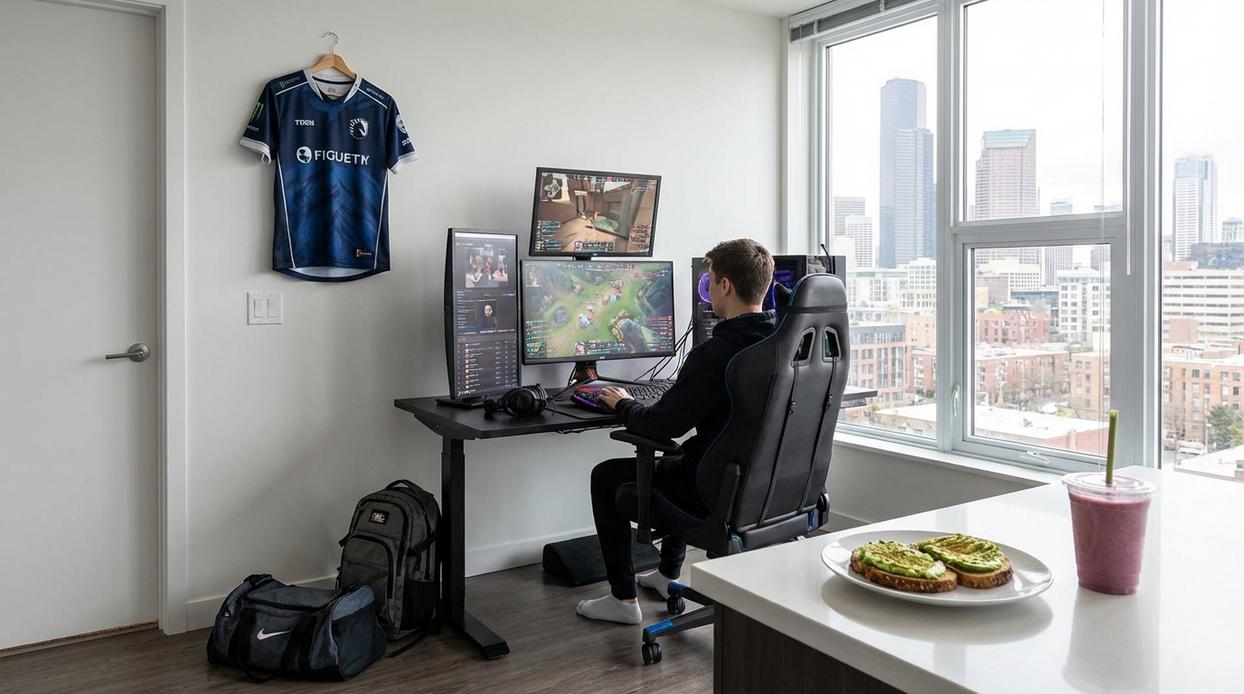
The room smells faintly of energy drinks and dry-erase markers. Keyboards rest silent for now. This is where intention replaces instinct. A scrim (short for “scrimmage,” meaning a structured practice match against another team) only works if everyone knows the goal. Maybe it’s testing a risky composition or tightening early-game rotations. The coach’s voice is calm but precise, VOD clips flickering on screen. You can almost feel the quiet hum of focus settle in (like the calm before a storm in an esports anime).
12:00 PM – Scrim Block 1
Headsets on. The sharp click of mechanical keys fills the air. This 2–3 hour block isn’t about the scoreboard—it’s about execution. Players track cooldowns, call out enemy positions, and test timings until they’re second nature. Losses sting, sure, but they’re data. And data is gold.
- Test new compositions under pressure
- Refine communication clarity
- Practice objective control setups
03:00 PM – Lunch & Mid-Day Review
The taste of something quick—rice, chicken, maybe a protein shake—barely registers. Screens glow again as the coach rewinds key moments. Mistakes are paused, dissected, corrected. Adjustments are mapped out with surgical clarity.
04:00 PM – Scrim Block 2
Now the room feels warmer, heavier. Lessons from earlier echo in every callout. Rotations tighten. Combos land cleaner. This is the grind behind the professional gamer lifestyle—deliberate, repetitive, intensely focused. By the end, wrists ache and voices grow hoarse, but improvement is tangible, almost electric in the air.
The Evening Session: Individual Skill Refinement
06:00 PM – Dinner & Decompression
First, step away. No VODs. No patch notes. Just food and a mental reset. High-level competitors treat this as a performance tool, not laziness. Cognitive science shows decision fatigue reduces reaction accuracy over extended sessions (Baumeister et al., 1998). In other words, grinding nonstop can backfire. Some argue pushing through builds endurance. However, most elite players protect this window because sharp mechanics require a fresh brain (think Formula 1 pit stop, not endless laps).
07:00 PM – Solo Queue & Mechanical Grind
Next comes targeted solo queue. This isn’t “just ranked.” It’s deliberate practice—repeating a micro-skill with intention, like animation canceling or off-angle positioning. Many competitors overlook structured goal-setting here. The edge? Queue with a written focus (e.g., first 10 minutes: wave control only). Pro tip: limit hero expansion to one new pick per week to avoid shallow mastery. This block quietly defines the professional gamer lifestyle.
09:00 PM – Personal VOD Review or Streaming
Finally, review your own gameplay. Pause at every death and ask: mechanical error or decision error? Most players skip this uncomfortable step. Alternatively, streaming sharpens communication skills and fulfills sponsor obligations—key to building visibility, much like strategies outlined in how top streamers build loyal communities. Ultimately, refinement beats raw hours every time.
Off-Screen Essentials: The Pillars of a Sustainable Career
Talent alone won’t sustain a career; mental resilience will. Early on, I ignored sports psychology, assuming grinding longer hours was the answer. It wasn’t. Burnout hit hard—slower reactions, irritability, and poor decision-making under pressure. A sports psychologist taught me that burnout is chronic physical and emotional exhaustion caused by prolonged stress (American Psychological Association). Learning breathing resets and structured decompression between scrims changed everything.
The business side surprised me too. Sponsor calls, media interviews, and content shoots can quietly drain energy. I once treated them as afterthoughts and showed up unprepared—rookie mistake. Now I block prep time because visibility fuels longevity in the professional gamer lifestyle.
- Schedule real downtime: hobbies, offline friends, zero screens.
Downtime isn’t laziness; it’s recovery science. Studies show deliberate rest improves performance and creativity (Harvard Business Review). Ignore it, and the game eventually ignores you back.
Talent gets attention, but structure builds champions. The professional gamer lifestyle is a full-time job powered by deliberate routines, not lucky streaks. Many players dream about going pro yet underestimate the discipline gap between ranked grind and competition. That gap is filled with schedules: team scrims, VOD reviews, solo mechanics drills, strength training, and mental resets.
Consistency beats bursts of motivation.
Here’s what to do:
- Block practice hours and protect them.
- Track performance metrics.
- Prioritize sleep, nutrition, and mobility.
- Schedule mindset work like meditation or journaling.
Start scale steadily, and treat ambition like career today.
Level Up Your Next Move
You came here to better understand the evolving world of competitive gaming, smarter strategies, optimized gear, and what it really takes to thrive in the professional gamer lifestyle. Now you have the clarity to move forward with confidence.
The reality is this: falling behind on mechanics, meta shifts, or equipment upgrades can cost you wins, rankings, and real opportunities. In a space that moves this fast, hesitation is a disadvantage.
Act on what you’ve learned. Tighten your strategies. Refine your setup. Study trends before they peak. The players who adapt first are the ones who stay on top.
If you’re serious about sharpening your edge and staying ahead of the competition, start applying these insights today and keep tracking emerging trends. Thousands of competitive players rely on our in-depth breakdowns to stay informed and win more consistently.
Don’t just play the game. Master it. Your next rank-up starts with your next move.