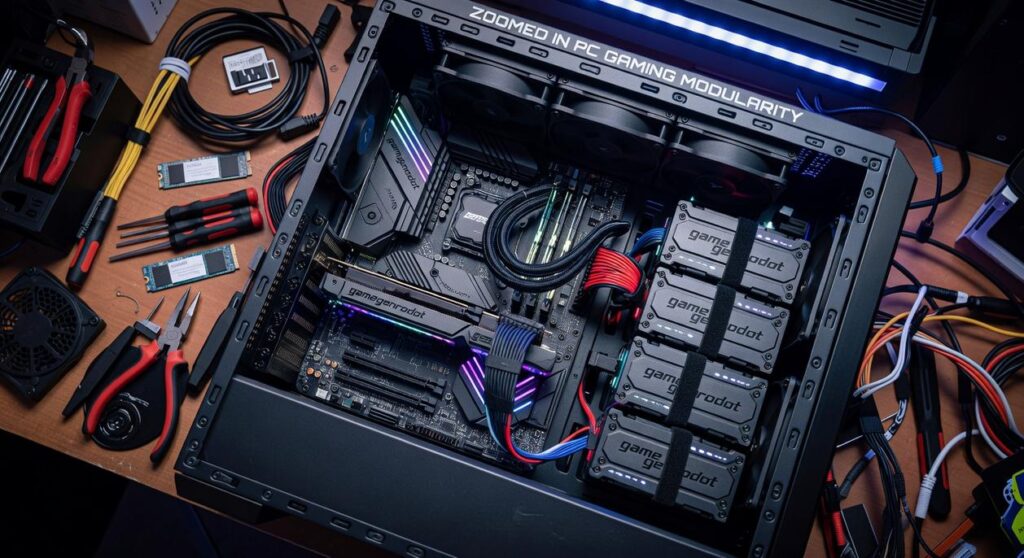
I’ve been playing games for decades and most customization systems still feel like window dressing.
You swap out a skin. You pick a talent from a tree. Maybe you get a 5% damage boost. But the core of how your character plays? That stays the same.
PC gaming has the horsepower to do better. Way better.
Modularity in games should mean more than choosing between three preset builds. It should let you break down abilities to their smallest parts and rebuild them into something that actually feels like yours.
That’s what I want to show you here. Not theory. Real examples of how zoomed in mechanical customization changes the way you play.
I’m using Genrodot as the main example because it gets this right. The game lets you tinker with ability components at a level most designers won’t touch. You’re not just picking options. You’re building the options.
This article breaks down what enhanced modularity actually means. You’ll see how it works in practice and why it matters for strategy.
By the end, you’ll understand the difference between cosmetic choice and mechanical depth. And you’ll know what to look for in games that claim to offer real customization.
Defining Enhanced Modularity: The New Frontier of Customization
Most games let you pick a class and call it customization.
You’re a mage or a warrior. Maybe you get to choose between fire spells or ice spells. That’s it.
But that’s not what I’m talking about here.
Enhanced modularity is different. It’s about breaking down abilities into their actual components and letting you rebuild them from the ground up.
Think about it like this. Traditional customization is painting a pre-made model. You get to pick the colors but the shape is already decided. Modularity? That’s building with LEGOs. You have the bricks and you decide what gets built.
Here’s what that looks like in practice.
In a traditional system, you might choose a fireball spell. You can increase its damage or reduce its cooldown. Those are your options.
With game genrodot zoomed in pc gaming modularity, you’re not just tweaking numbers. You’re deciding how the ability actually works:
- What triggers the effect
- How it travels or spreads
- What happens on impact
- How it interacts with other systems
You’re swapping out functional components. Combining mechanics that weren’t meant to go together. Altering the logic of an action itself.
Some designers think this is too complicated. They say players just want simple choices and clear paths to power.
But I’ve seen what happens when you give players real building blocks. They don’t get confused. They get obsessed.
The skill ceiling shoots up. Strategy becomes about understanding systems, not memorizing rotations. And the meta stays fresh because players keep finding combinations no one thought of.
That’s why this matters for genrodot. We’re not just talking about another progression system. We’re talking about giving players actual agency over how their character functions.
Case Study: A Deep Dive into Genrodot’s ‘Ability Matrix’ System
Most games give you a skill tree and call it a day.
You pick Fire Bolt or Ice Bolt. Maybe you get a passive that makes it 10% stronger. That’s about it.
Genrodot‘s Ability Matrix works differently.
Instead of locked-in skills, you get building blocks. Three types: Triggers (how an ability activates), Payloads (what it actually does), and Modifiers (how you twist the behavior).
Think of it like this. You’re not choosing between premade abilities. You’re assembling them from parts.
Let me show you what I mean.
Turning a Sniper Shot into a Crowd Control Monster
Start with a basic Kinetic Bolt. Simple stuff. You cast it (Trigger: On-Cast), it flies forward, hits one enemy for kinetic damage (Payload: Kinetic Damage).
Now add the Chain modifier.
Suddenly your bolt bounces to a second target. Still kinetic damage, but now you’re hitting two enemies instead of one.
But here’s where it gets interesting. Swap out that Kinetic Damage payload for Cryo Burst.
What happens? Your single-target projectile becomes an area-of-effect cold bomb that jumps between enemies. You went from a precision tool to a freezing crowd controller in two steps.
I call it a Ricocheting Frost Nova (not the official name, but you get the idea).
Defensive Abilities That Bite Back
Take a standard Barrier ability. It absorbs damage until it breaks. Basic protection.
Add a Detonate on Break modifier and now your shield explodes when enemies shatter it. You’re punishing them for attacking you.
Or go a different route. Slot in a Lifesteal modifier instead. Now every hit your barrier takes siphons health back to you. How to Download Genrodot Game for Pc builds on the same ideas we are discussing here.
Same base ability. Two completely different functions.
| Component | Basic Version | Modified Version 1 | Modified Version 2 |
|---|---|---|---|
| Trigger | On-Cast | On-Cast | On-Cast |
| Payload | Damage Shield | Damage Shield + AoE Burst | Damage Shield |
| Modifier | None | Detonate on Break | Lifesteal on Hit |
| Function | Block damage | Block then explode | Block and heal |
The game genrodot zoomed in pc gaming modularity to a degree I haven’t seen before. And honestly? I think this is where ability customization is headed.
Here’s my prediction. Within two years, at least three major RPGs will copy this system (or something close to it). The days of static skill trees are numbered.
Why? Because players want control. We’re tired of being told “you’re a fire mage” or “you’re a tank.” We want to experiment. We want our Barrier to explode and our projectiles to ricochet.
Some people will say this makes balancing impossible. That giving players this much freedom breaks PvP.
Maybe. But I’d rather have interesting problems than boring solutions.
The Matrix system isn’t perfect yet. But it’s pointing toward something better than what we’ve had.
The Gameplay Impact: Strategy, Emergence, and Player Expression
You know what kills a game faster than bad graphics or server issues?
When everyone runs the same build.
I’ve watched it happen over and over. A game launches with promise, players figure out the optimal setup within weeks, and suddenly every match feels identical. The meta crystallizes and the game dies.
But here’s where game genrodot zoomed in pc gaming modularity changes everything.
When you have thousands of possible component combinations, the meta can’t settle. There’s always something new to test. Some weird interaction you haven’t tried yet.
I’m talking about real depth here.
Emergent Gameplay That Surprises Everyone
The best part? Players will find synergies that slip past developers entirely.
I’ve seen it happen in games with even basic modular systems. Someone combines two components that seemed useless on their own and suddenly they’re dominating. That discovery spreads through the community and spawns ten more experiments.
That’s when a game feels alive.
Your Build, Your Signature
This isn’t about copying the top player’s loadout anymore. You’re building something that reflects how you actually play.
Maybe you prefer hit-and-run tactics. Or you like to control space. The modular system lets you express that instead of forcing you into preset archetypes.
Your playstyle becomes recognizable. People see you coming and know they’re in for something specific.
The Complexity Question
Look, I won’t pretend this is simple.
Some players will freeze up when faced with too many options (analysis paralysis is real). New players might feel overwhelmed at first.
But that initial learning curve pays off. Once you understand the core components, experimentation becomes the fun part. You’re not grinding the same rotation for months. You’re testing theories and refining your approach.
For dedicated players, that depth is exactly what keeps them coming back.
The Future of Game Design: Lessons from Genrodot’s Success
Most games give you options.
Genrodot gives you control.
There’s a difference. And I think it’s going to change how we think about what makes a game worth playing for years instead of weeks.
Look at traditional shooters. You pick a loadout. Maybe swap attachments. But the gun still behaves the same way for everyone. Now compare that to what happens when you let players rebuild the core mechanics themselves.
That’s where game Genrodot zoomed in pc gaming modularity becomes something bigger than just another feature.
Some designers worry this approach is too complex. They say most players just want to jump in and play, not tinker with systems for hours. And sure, there’s truth there. Not everyone wants to be an engineer.
But here’s what that argument misses.
The players who stick around? The ones who build communities and keep your game alive three years after launch? Those are exactly the people who want this level of control.
I’ve seen what happens when you give players real creative freedom. They don’t just play your game. They reinvent it.
Think about strategy games. Right now you move units around a map. But what if you could customize how those units make decisions? Change their AI behavior based on what you need?
Or racing sims where engine swaps actually change how the car handles in ways you can feel.
This isn’t about adding more menus. It’s about treating players like creators instead of consumers.
When you download Genrodot, you’re not just getting another game. You’re getting a toolset.
That shift matters more than most studios realize.
Building Your Perfect Playstyle
You came here to understand how Genrodot breaks the mold.
Most games give you surface-level choices. Pick a class. Choose a skill tree. Call it customization.
Genrodot does something different.
I designed this system because I was tired of being locked into predetermined playstyles. You should be able to control the mechanics of your actions, not just pick from a menu of preset options.
Enhanced modularity changes everything. It breaks abilities down into their fundamental components and hands you the toolkit.
Want a fast projectile with low damage and high pierce? Build it. Prefer a slow-moving area denial skill that stacks debuffs? That works too.
The system gives you control over what matters. Speed, damage type, targeting behavior, resource cost. You’re not just selecting abilities anymore. You’re engineering them.
This is what real customization looks like. No two players will approach combat the same way because the possibilities branch out in too many directions.
Game design is evolving past the old template systems. Genrodot proves that players can handle complexity when you give them the right tools to manage it.
Your next step is simple. Start experimenting. Break down the mechanics you rely on and rebuild them to match how you actually want to play.
The PC gaming space needed this shift. Now you have it.